


Recently, the Ningbo Daily reported on the construction site of the main stadium project of the second phase of the Ningbo Olympic Sports Center under the headline "Robots on Duty: Laying Bricks and Building Walls 24 Hours a Day": UAV inspections, surveying robots, ground leveling robots, troweling robots, plastering robots, and other "robot comrades" are working collaboratively, as the construction industry is moving from "human wave tactics" to "human-machine collaboration."
As a construction robot enterprise deeply rooted in the scenarios of interior wall plastering and steel bar processing, Weijian Technology (Ningbo Weijian)'s plastering robot entered the media lens along with the intelligent construction system of the second phase of the Ningbo Olympic Center, becoming a concrete footnote to the "replacing humans with machines, improving quality and efficiency" of key projects in Zhejiang.
The work of a single wall is being redefined
Traditional interior wall plastering—mixing mortar, applying it, smoothing it, and patching edges—relies on waist strength, experience, and the touch of master craftsmen. Young workers are unwilling to learn, skilled workers are becoming increasingly scarce, and hollow spots, cracking, and unstable verticality are the "old problems" that most headache general contractors and clients.
In large-scale, high-standard, and tight-schedule venue projects like the second phase of the Ningbo Olympic Center, Weijian's plastering robot walks autonomously along BIM data and on-site measured points:
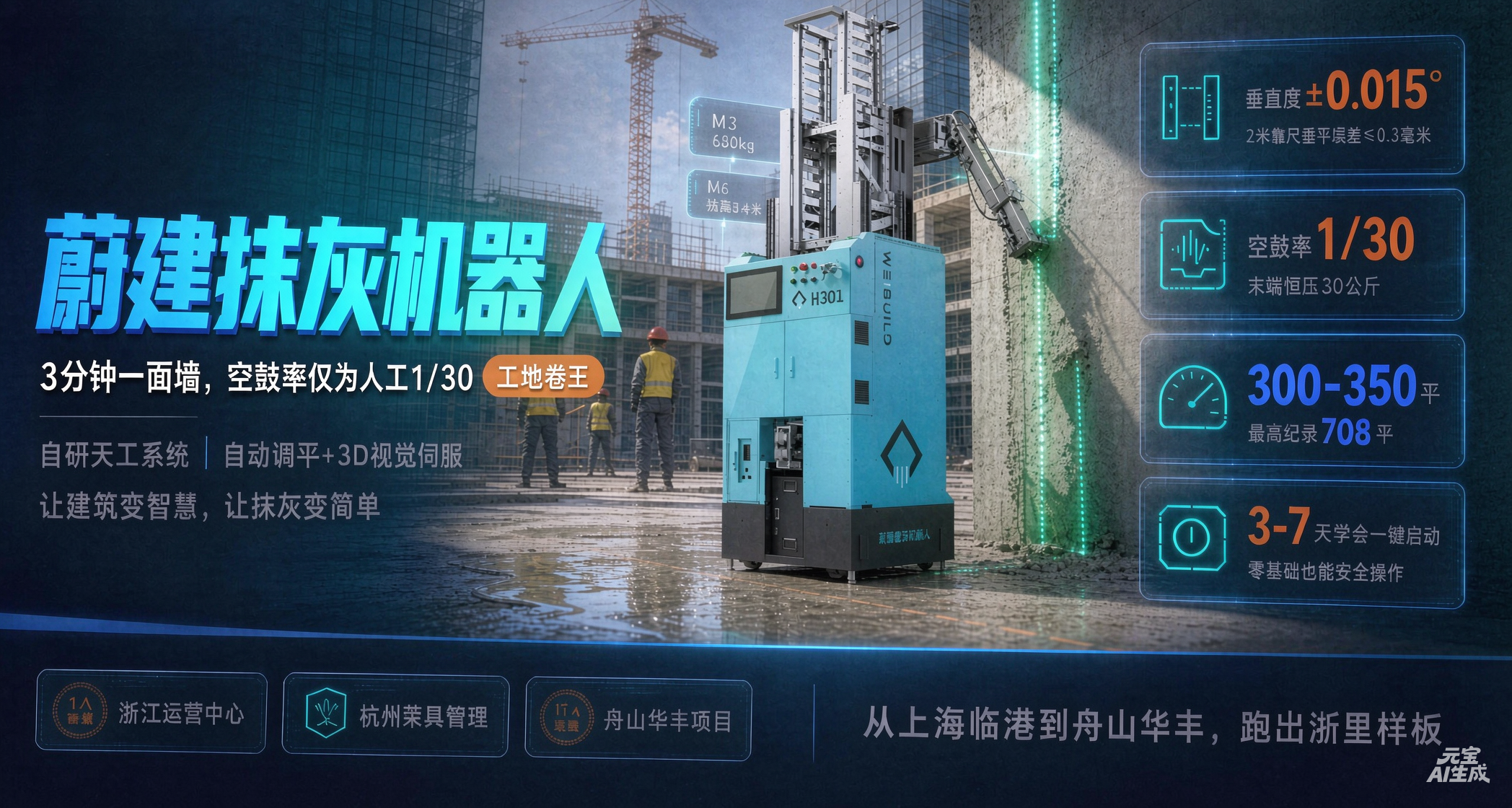
3D vision positioning + automatic leveling, verticality deviation ±0.015°
30kg-class constant pressure troweling, joint precision ±1mm, no hollow spots or cracks on the wall surface
One trowel every 3 minutes, daily plastering of 300–350㎡, with a record high of 708㎡/day
Zero-foundation machine operators can be on duty after 3–7 days of training, with 1 person handling relocation + edge patching, while the machine handles the large surfaces
It has cumulatively completed over 4 million square meters of construction verification nationwide
To use the words from the project: "Large surfaces are left to Weijian robots, details to humans, and quality records to the system."
Ningbo Olympic Center Phase II: Intelligent construction is not for show
The Ningbo Daily report mentioned that the second phase of the Ningbo Olympic Center has promoted intelligent construction from "single-point demonstrations" to "system collaboration," with project efficiency improved by about 40%, the construction period shortened by about 300 days, and the prefabrication assembly rate reaching 62%.
For Weijian, entering key projects is not about filming a video, but about turning the "dirty, tiring, dangerous, and human-dependent" process of interior wall plastering into a deliverable construction capability:
Before entering the site: Verify floor height, wall material, door and window openings, and mortar ratio
After calibration: The robot works according to the drawings, with verticality data recorded in real-time
During construction: Machine operator supervision + relocation, with manual labor only patching door and window openings, internal and external corners, and pipe bases
After delivery: Generate engineering quantity and quality records for each floor, building, and project, and interface with general contractors and supervisors for acceptance
Scan to follow